


Research
Publications
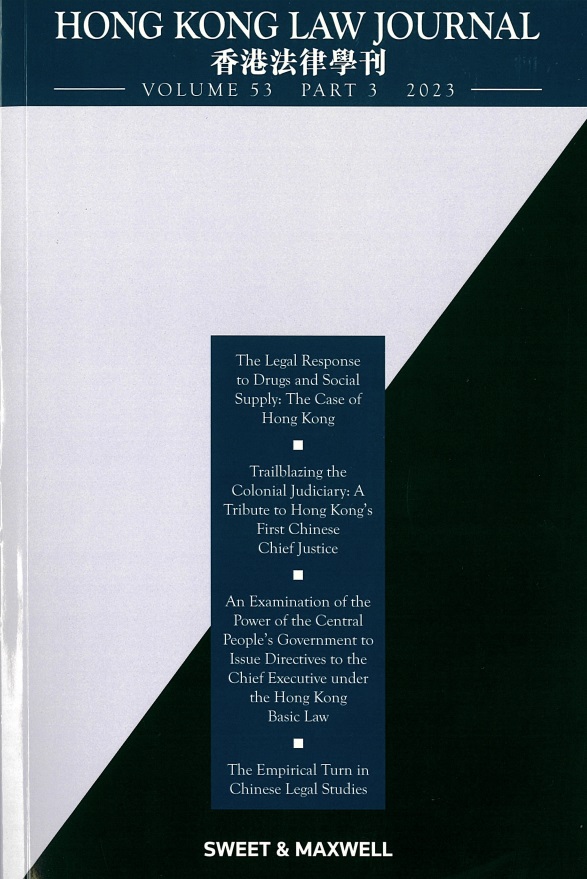
Benjamin Chen and Yin Xiaohan
Data Still Needs Theory: Collider Bias in Empirical Legal Research
Big data is characterised not only by the amount but also the kinds of information that can be created, stored, and processed. This explosion of data, accompanied by the capacity to analyse them, has catalyzed large n, quantitative approaches to the study of law and legal institutions. But neither size nor quality guarantees the validity of causal inferences drawn from observational data.…
December 31, 2023

Taorui Guan
Intellectual Property Legislation Holism in China
This article argues that conventional analysis of China’s intellectual property (IP) system, which focuses narrowly on the adequacy of rights protection, overlooks a fundamental transformation in its legislative philosophy. The author contends that since the promulgation of the Outline of National Intellectual Property Strategy in 2008, China has adopted an approach of “intellectual property legislation holism”. This holistic framework moves beyond mere protection…
December 12, 2023

Taorui Guan
Investors’ Perspective on Intellectual Property Financing
The intellectual property system is generally considered to be a legal system that promotes innovation. But the ways through which it achieves this goal are still not entirely clear. Conventional intellectual property theories tend to describe the system’s role in promoting innovation as providing creators with incentives to create and commercialize intellectual products, as well as disseminating knowledge to potential users. What…
November 28, 2023

Kelvin Low, Edmund Schuster, and Wai Yee Wan
The Company and Blockchain Technology
Blockchain and distributed ledger technology (DLT) have generated much excitement over the past decade, with proclamations that they would disrupt everything from elections to finance. Unsurprisingly, the much-maligned corporate form is also considered ripe for disruption. While certainly imperfect, and currently serviced by creaking legal infrastructure premised upon direct shareholdings, are its problems ones of centralization/intermediation? What exactly are the limits of…
August 11, 2023

Mingruo Yuan, Ben Kao, Tien-Hsuan Wu, Michael M. K. Cheung, Henry W. H. Chan, Anne S. Y. Cheung, Felix W. H. Chan, Yongxi Chen
Bringing Legal Knowledge to the Public by Constructing a Legal Question Bank Using Large-scale Pre-trained Language Model
Access to legal information is fundamental to access to justice. Yet accessibility refers not only to making legal documents available to the public, but also rendering legal information comprehensible to them. A vexing problem in bringing legal information to the public is how to turn formal legal documents such as legislation and judgments, which are often highly technical, to easily navigable and…
July 6, 2023
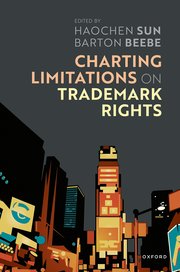
Haochen Sun and Barton Beebe (NYU)
Charting Limitations on Trademark Rights
Trademark scholarship has focused largely on the protection of trademark rights against consumer confusion and the dilution of trademarks. Studies of limitations on trademark rights, meanwhile, have remained relatively peripheral, especially in jurisdictions outside of the United States. However, this reality is incongruous with the importance of the limitations, such as descriptive and nominative uses, in promoting freedom of commerce, market competition,…
May 12, 2023
Benjamin M. Chen, Zhiyu Li, David Cai & Elliott Ash
Detecting the Influence of the Chinese Guiding Cases: A Text Reuse Approach
Socialist courts are supposed to apply the law, not make it, and socialist legality denies judicial decisions any precedential status. In 2011, the Chinese Supreme People’s Court designated selected decisions as Guiding Cases to be referred to by all judges when adjudicating similar disputes. One decade on, the paucity of citations to Guiding Cases has been taken as demonstrating the incongruity of…
May 6, 2023
Timothy Chan and Kelvin Low
DeFi Common Sense: Crypto-backed Lending in Janesh s/o Rajkumar v Unknown Person (‘CHEFPIERRE’)
One of the selling points of cryptoassets has been the ability to subject them to so-called ‘smart contracts’ embedded upon blockchains; yet, despite numerous common law decisions accepting cryptoassets as property, until Janesh s/o Rajkumar v Unknown Person (‘CHEFPIERRE’) no courts have had the occasion to consider how such property (in this case, an NFT) interact with these ‘smart contracts’. The case…
March 29, 2023

Haochen Sun
Elite Universities as Luxury Brands
The 2019 college admissions bribery scandal revealed uncomfortable truths about elite higher education and its conspicuous consumption. In this chapter, I explore the legal implications of treating higher education as a luxury good reflecting wealth and status. Like luxury goods companies, elite universities are regarded as owners of luxury brands. Just as companies such as Louis Vuitton, Ferrari, and Hermès own brands…
July 1, 2022

Taorui Guan
Contractual Bundles for Innovation
The question of how contracts promote innovation has long attracted scholars’ attention. This Article tackles this question by studying one contractual mechanism — bundling arrangements — that innovators frequently use to transfer other assets along with a patent license. It examines 400 patent licensing transactions that public companies filed with the Securities and Exchange Commission, and finds that 42.25% of them included…
February 6, 2023